

How Much Does a Website Cost in Ireland? A Straight Answer for Small Businesses.
If you’ve ever asked a web designer how much a website costs, you’ve probably got the classic answer.
“It depends.”
Which is technically true, but not very helpful when you’re trying to budget properly. So instead of dancing around it, let’s put some real numbers on the table and explain what you’re actually paying for without all the waffling.
Average Website Costs in Ireland.
For a small business in Ireland, you’re generally looking at three price ranges depending on what you need.
Basic Website (DIY or Template Build)
€200 to €800
This is usually done using platforms like Wix or Squarespace. You’re using templates, dragging things around, and figuring it out as you go.
It works for very early stage businesses, but you’re trading money for time and often ending up with something that looks grand but doesn’t actually bring in leads.
A lot of small businesses tend to go this route and ‘give it a bash’ themselves, but it rarely works out as they hope and it takes a huge amount of time (if you don’t know what you’re doing).
This is not to say the drag and drop builders can’t be used to make deadly website in fairness.
On a final note here – heads up: if you’re getting a website built from some lad for €200, you’re more than likely going to end up with something shite, either that or you’ll get a copy/paste generic site with your info thrown on top. Cheap website design in Ireland is all too common but rarely gets results.
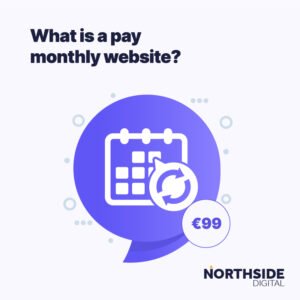
Saying that, there is a low-cost route to a high value website using no upfront payment, monthly fee websites.
Professional Small Business Website
€800 to €3,000
This is where most small businesses should be aiming.
You get:
- A proper design that reflects your brand
- Mobile optimisation
- Basic SEO setup
- Contact forms and clear calls to action
According to Enterprise Ireland, investing in a strong online presence is one of the key drivers of growth for small businesses, especially in competitive local markets.
This level is where your website starts working for you instead of just existing.
Custom or Advanced Website
€3,000 to €10,000+
This is for larger businesses or more complex builds. In this territory you’d also be looking at e-commerce website builds as well.
You’d likely be talking about:
- Booking systems
- Membership areas
- Custom integrations
- Advanced SEO strategies
Having the bells and whistles generally doesn’t come cheap but you’d be expecting a high quality end product in this band. Agencies charging at this level are usually building something very tailored, not just a brochure site.
What Actually Drives the Cost of a Website?
The price isn’t random. There are a few key things that push it up or down.
1. Design vs Template
A custom design takes time. You’re paying for thinking, not just building.
Templates are quicker and cheaper, but you’re working within limits. That’s why a lot of template sites end up looking very similar.
However, saying that, using a powerful template framework to build custom websites is usually the best output (depending on your budget).
2. Number of Pages
A five page site is very different to a twenty page site.
If you have loads of products or services that need to be added to your website, the cost can increase significantly.
Each page needs:
- Layout
- Content
- Optimisation
That all adds up.
3. Content and Copywriting
A big one people overlook – people generally tend to assume that the website designer creates the content too (some do in fairness, including us), but that isn’t always the case. I’ve seen projects come to a halt and eventually a complete stop because the client can’t provide content.
If you’re expecting the developer to also write your content, structure your pages properly, and make it convert, that’s a different job altogether.
Good content is the difference between a site that looks nice and one that actually brings in enquiries.
4. SEO Setup
A website without SEO is like opening a shop in the middle of nowhere.
Basic SEO should include:
- Page titles and meta descriptions
- Proper heading structure
- Internal linking
- Google indexing setup
More advanced strategies such as backlinking, citation building, content stratgy will cost more than a basic setup obviously, but it’s a strong investment – a well optimised website will bring you in traffic and customers organically e,g, without the need to spend on advertising.
Guidance from Google Search Central makes it clear that structure and relevance are key ranking factors, even before you get into more advanced SEO work.
5. Ongoing Support and Maintenance
Some quotes include ongoing support. Others don’t. Having an experienced developer at hand to make sure your website is actually getting you traction and working properly is a shrewd investment.
They generally cover:
- Updates
- Security
- Small changes
- Hosting
- SEO strategy
Always check what’s included because this is where costs can creep in later.
Why Some Websites Are So Cheap (And Others Aren’t)
You’ll see people offering websites for €200, and others charging €5,000.
They’re not the same product.
Cheap websites are usually:
- Template-based
- Minimal SEO
- Little to no strategy
- Built quickly
- Copy/paste
- Built by inexperienced designers or
- Build by experienced designers who don’t give a shit
More expensive websites include:
- Proper planning
- Conversion-focused design
- SEO structure
- Clear focus on User Experience and Conversion Rate Optimisation
- A clear goal behind every page
What You Should Budget (Realistically).
If you’re a small business in Ireland and you’re serious about growth, a realistic starting budget is:
€1,000 to €2,500
That puts you in the range where:
- Your site looks professional
- It’s built properly
- It has the foundations for SEO
- It can actually convert visitors into leads
Anything below that, and you’re usually making compromises somewhere.
Research from Statista shows that users form an opinion about a website in a matter of seconds, which is why design and usability are not just nice extras. They directly impact whether someone trusts your business.
Don’t Just Ask “How Much?”
The better question is:
“What am I getting for this?”
Because a cheap website that does nothing is more expensive in the long run than one that brings in even a few customers a month – as the old saying goes: buy cheap, buy twice.
If your website can generate leads consistently, it pays for itself fairly quickly. That’s the real way to look at it.



 How can we help?